Monday, February 22, 2016

First Salt Garden Experiment

When looking up easy to grow crystals, I found a great source of information on salt gardens (and many other awesome projects!) at waynesthisandthat.com, site owner Wayne Schmidt. I used the recipe which can be found here.

I was intrigued by the different variables that could affect the salt crystal growth, some of which were already described on the site. I decided to explore the effects of varying the amount of liquid bluing and ammonia. The amount of bluing would be either 4, 8, or 12 tbsp and the amount of ammonia would be either 4 tbsp, 2 tbsp, or none and then 8 tbsp added to the solution on the third day. Testing each combination gave me 9 different samples, which I labelled samples A through I. These are listed below under "sample amounts".

Note: This experiment lasted about two weeks. During that time, I measured humidities between 41 and 52% and temperatures between 66 and 77 degrees Fahrenheit in my closet where the samples were set.


Ingredients and materials:
-4 tbsp tap water
-4 tbsp table salt
-liquid bluing (see sample amounts)
-ammonia (see sample amounts)
-charcoal pieces
-vaseline
-plastic containers
-tbsp measure
-gloves
-goggles


Sample Amounts:
Sample A
4 tbsp liquid bluing
4 tbsp ammonia

Sample B
8 tbsp liquid bluing
4 tbsp ammonia

 Sample C
12 tbsp liquid bluing
4 tbsp ammonia

Sample D
4 tbsp liquid bluing
2 tbsp ammonia

Sample E
8 tbsp liquid bluing
2 tbsp ammonia

Sample F
12 tbsp liquid bluing
2 tbsp ammonia

Sample G
4 tbsp liquid bluing
no ammonia then 8tbsp on 3rd day

Sample H
8 tbsp liquid bluing
no ammonia then 8tbsp on 3rd day

Sample I
12 tbsp liquid bluing
no ammonia then 8tbsp on 3rd day


Documentation:
Recipes completed at 4:00pm on 2/9/16.
the setup


After 2 hours: I sprinkled four pinches of salt on top of each of the charcoal pieces. (At this point, no visible crystals have started forming yet.) Sample A's solution has turned a dark, brownish red color, but all the other samples remain a dark blue.


After 4 hours (2 hours after additional salt was added): Crystal can be seen growing on top of all of the charcoal briquettes. Upon closer inspection, the brownish red solution of sample A is growing plenty of salt underneath the surface. Sample D's solution is turning a dark yellow, and sample B has patches of yellow as well. The liquid bluing appears to have settled to the bottom of each container. With the exception of samples G, H, and I, all the samples have at least some crystals forming on the edges of the briquettes and the bottom of the container.


After 48 hours: Most the samples look roughly the same as they did when I last checked. However, sample F has begun to clearly grow crystals upwards from the coal briquette.


After 72 hours (3 days):
In addition to sample F, samples A and D have also begun to acquire salt crystal growth. Sample A's growth has overtaken sample F, so far doing the best of the three.


After 96 hours (4 days):
Since it took a while for the solutions to evaporate, I waited until the 4th day (instead of the 3rd) to add more solution. Since none of the samples needed much additional liquid, I made a half recipe for each sample, except for samples F, H and I, for which I made quarter recipes.

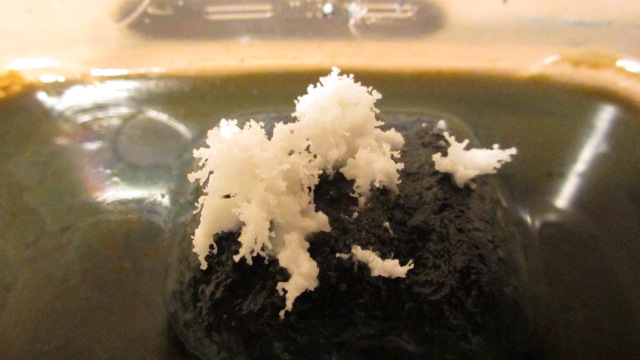
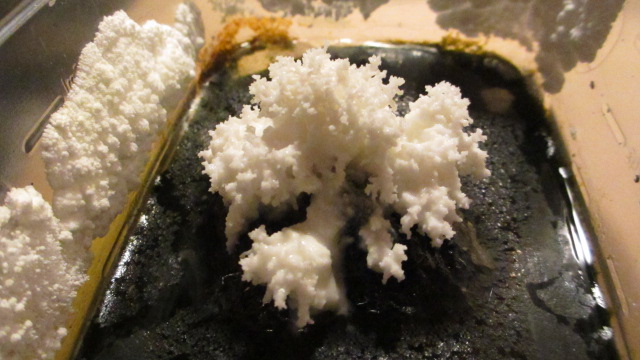
Pictures were taken before adding the additional solution. At this point, all of samples A through F have vertical crystal growth except for sample C. Although samples G, H and I are not yet growing crystals in the vertical direction (probably since there is no ammonia in the solutions yet), they have changed somewhat since the first day; salt is forming over the surface of the briquettes, and has a sort of "crackle" appearance. There are also deposits of salt forming on the upper sides of the briquettes.
Dry "crackle" appearance on sample H after 96 hours


After 108 hours (4.5 days):
12 hours after adding the additional solution, noticeable salt crystal growth can be seen since the previous set of pictures. At this point, all 9 samples have some degree of vertical crystal growth. Samples G, H, and I have more feathery looking growths at this point, which have sprung up quite quickly. The solutions have a red tinge under the surface, much like sample A did at the very beginning of the experiment. These effects are likely due to the ammonia being added for the first time for these three samples, and to there being more of it than in any of the other samples.


Day 11: Samples A, G, and H appear to be doing the best at this point. Even the samples which have quite a bit of crystal growth, however, still have "soggy" patches. Perhaps the humidity is too high? Or the crystals were disturbed at some point and collapsed? I may experiment with a fan set to low in the future, as suggested in the original recipe. (I didn't want to use a fan for this first experiment as I didn't want it to blow across some samples more than others, skewing the results.) In contrast, samples B and C are lagging far behind the other samples, as they still only have a tiny dot of growth.


Day 13: Samples B and C have finally begun to develop a noticeable amount of salt crystal growth. Samples H and I have salt crystals growing on the sides of the container. These may soon grow right over the top. I only put vaseline on the sides about an inch above the solution, and the crystals seemed to have skipped right over this section and only grown above it. Interestingly, while all the samples have slightly soggy crystals forming on the briquettes, the crystals forming on the sides of H and I's containers are not soggy at all. They're also have a more rounded appearance rather than the feathery look of the crystals growing on the briquettes.

Overall, samples A, G, H, and I seem to have formed the largest growths, with sample A staying in the lead most steadily throughout the experiment. This suggests that the ratio suggested in the original recipe does quite well (sample A) and that adding the ammonia in after a few days may also be worth trying out (samples G, H, and I). Also worth noting; having higher ratios of bluing to ammonia seems to produce poorer results (samples B and C did worse when compared to sample A, and samples E and F did worse when compared to sample D).


Each samples on the 13th day:
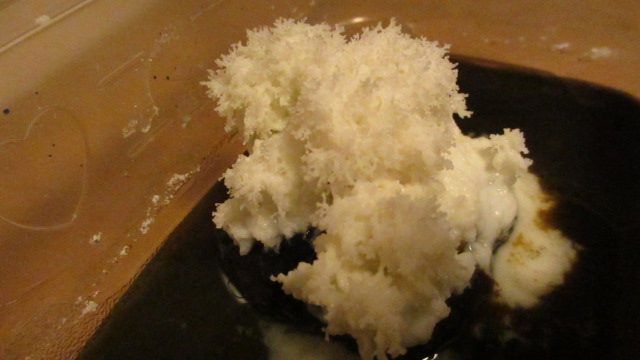
Sample A

Sample B

Sample C

Sample D

Sample E

Sample F

Sample G

Sample H

Sample I


While I took pictures of every sample at various intervals (4, 72, 96, 108 hours and days 11 and 13), it would take up too much space to include all of them here. So here is an example of the salt crystal growth for just sample A:
After 4 hours

After 4 hours - closeup

After 72 hours

After 96 hours

After 108 hours

Day 11

Day 13

Friday, February 19, 2016

Short Poem

I found a short poem I wrote about three years ago.

And I am going to wander,
Until I chance encounter,
Those other brave lost souls,
Who walk the lonesome voids,
Between other people's cold unforgiving walls.

Thursday, February 18, 2016

Mental Trick for Changing One's Personal Story

You may have heard the trick of imagining your ideal self and then imagining you are already that person (or thinking of your goal and then visualizing having it). This has to do with the idea that we are "talking to ourselves" all day in our heads, and that what we say to ourselves reflects our view of ourselves and what we're capable of - our personal stories. Rather than trying to change individual behaviours with a brute force method, we could instead change the internal story which led to the behaviours in the first place.

Unfortunately I have found that it often doesn't work to simply tell myself that I am the person I want to be. Perhaps this is because if I tell myself that, for example, I am someone who is always considerate and acts accordingly, this works right up until I do something from long standing habit which does not "fit" this model. Then the illusion is shattered and I fall back into my old story.

Perhaps I need to adjust the story of who I want to be such that it is compatible with the transition. In other words, make the goal not just some static standard of perfection, but an ideal process. So instead of, "I want to be someone who is always considerate", it would be more like, "I want to be someone who strives to be considerate, and when she does something inconsiderate takes the necessary action to learn from it and make things right." Notice that the former statement is unobtainable, and that the latter statement is completely doable.


There's a big issue of guilt in my personal stories. It seems I tell myself something like, "I want to be someone who never does anything she should feel guilty for". I describe the details of what I would do rather than state it this way, but that appears to be the underlying nature of the sentiment. Really, it is built upon the foundation of the concept of blame. If this concept is accepted, then I would always have to strive to be someone who acts in a blameless fashion. That is the supposed function of blame after all; to scare people into doing "the right thing" in order to avoid feeling guilty. Since there will always be people who blame even without good reason, avoiding it would be essentially impossible. My only alternatives would be to surround myself with a sufficient number of people who find me blameless in order to counteract this effect or to isolate myself from those who would blame me by labelling them as unreasonable or blameworthy themselves. These are common strategies, but short term solutions at best.

On a conscious level I choose to reject the blame/guilt model altogether. Guilt and self blame are not useful. They are counterproductive. They keep me stuck. I know this. Yet it appears to be the most difficult of all my thought patterns to break. There is an alternative world view; nobody is perfect. Everyone makes mistakes. The important thing is what we do after we make a mistake. Very cliche sounding, but how often do these concepts actually sink in? This view requires abstaining from blaming altogether, self and others. I can get quite far with not blaming others, but the circuit never quite completes itself when it comes to not blaming myself.


Doing something different and acknowledging something I regret seem to be... uncomfortable tasks at best. Unthinkable at worst. Why? If a person regrets what they did, wouldn't it be quite natural to state that something went wrong, why, and then implement a solution after the completion of their analysis? This would not require self hatred. It would not require unshakable guilt. It would simply require seeing that something went differently from the way one hoped, finding out why, and then looking for potential methods of improvement. Once again, the old blame model is standing in the way. But why is it so hard to shake, even conceptually?

One thing I find problematic is that, while internally the two perspectives could not be more different, externally I haven't figured out how to differentiate between them. I may design an action that I intend to take out of guiltless regret, no blame, just attempting to fix the miscommunication or poor technique. But this very action fits too easily into the blame model as well. My fear seems to be that it will look as though I have accepted the blame and the underlying assumptions; that I am a bad person, incompetent, irrational etc. The fear is that this will put me in a poor position in the future, as someone easily dismissed or looked down upon. Or others will think that by considering their needs so openly, I have decided to sacrifice my own, as would be dictated by the blame model.

(Note: there is likely something else at play as well which catapults me back into the blame model, as I often find self loathing springing up the instant I start actually considering the most logical mitigating action.)

So it appears I need a personal story that not only works for the transition process, but which also works for interfacing between the blame model that others might retain and my desired, guiltless regret model. That is, I need my new story to work without requiring others to accept the idea that blame is counterproductive and destructive and that change can be motivated quite easily without it.


I focused on one example in this post (overcoming guilt as an obstacle to becoming more considerate), but I'm sure the concept could be applied to just about any goal. The theory that seems to be emerging is that, when attempting to change one's personal story, the new story should meet a few requirements:
1) The goal should be realistically obtainable.

2) The new story needs to allow for a transition from the old story.

3) The new story needs to be compatible with other people's reactions and other effects.

Wednesday, February 17, 2016

Mental Tricks for Organizing

I like to take an analytical approach to organizing: sit down, write out the most efficient procedure to go through everything, and set up a sorting station. That usually involves coming up with categories of keep, trash, donate, and "belongs in x room". For example, if there are things in the dining room that belong in the kitchen, there will be a box labelled "kitchen" which later gets taken to the kitchen to be put away or sorted.

From experience, a "maybe" pile can be very helpful. Technically it doesn't seem like the most efficient thing to have, since one will end up looking at some of the same items more than once. However, it may speed up the decision making process. Anything where I have to pause to think about it, I just put it in the maybe pile instead of staring at it and creating a bottle neck. Then, once I've gone through everything else, I can go back to the maybe pile. Since I've seen everything else in the room, I have a better feel at this point for what I really need to hang onto. I have also had time to think about the item on a subconscious level, so that tends to gradually decrease my attachment to it.

As an example, I once went through about 500 books. They wouldn't fit on my shelves any more, not even double stacked. Many of the books were easy to make a decision about. However, there was a stack of over 100 books in the maybe pile. They were books I hadn't read yet and kept putting off, yet I kept telling myself I'd get around to it eventually. Or they were books I had read once that were mediocre, but I wasn't entirely convinced I wouldn't want to read it again someday. I let that pile sit overnight. In the morning, I didn't have to look again at any of them, I just immediately got rid of the whole pile. The logic was that it didn't make sense to keep a book I wasn't looking forward to reading, and it was so much easier to come to terms with that once rather than to go through it 100 times over.


I stumbled on another mental trick when I was trying to tidy up my room. I had formulated a plan for where everything would go and the most efficient order to complete tasks. And yet... I just couldn't seem to get into the process of cleaning my room. I knew exactly where the logical place to start was, but it was like pulling teeth trying to get myself to do it. The breakthrough came when I moved my music stand out of the main path. All of a sudden, it felt like I could move around easier. I cleared everything out of the path, then began dividing items up into general categories (books, clothes, cds, papers, etc.) and piled them up in various corners of the room. As soon as I did that, I was able to proceed easily with my original plan of action. I suspect the reason I kept getting stuck was because the clutter in my room was visually overwhelming, and clearing a space made it more manageable. Not to mention easier to walk.

Tuesday, February 16, 2016

Epsom Salt Crystals - Evaporation Method

Several sites suggest using a sponge or other porous material to give crystals something to grow on. Also, I noticed that while most recipes suggest a 1:1 ratio of water to epsom salts, some suggest a 2:1 ratio, so I decided to try this out and see if it worked.


Ingredients and materials:
1/2 cup water
1/4 cup epsom salts
sponge
container
food coloring (optional)


Recipe:
1) Heat the water (until it's not quite boiling), then mix in the epsom salts until dissolved. Optional: mix in food coloring.

2) Pour the mixture over a sponge in a small container.

3) Place in a warm, dry location and wait several days.


Documentation:
I made four bowls for the evaporation method, one without food coloring, and one with blue, red, and green food coloring respectively. I put three drops of each color directly onto each sponge and another drop mixed in with the water. The recipe was completed at 9:00pm on 2/7/16.

Note: I got a humidity and temperature monitor which collects the high and low temperature and humidity readings over the course of 36 hours. My closet, where I kept the samples, had a temperature of between 72 and 77 degrees Fahrenheit, and a humidity level of between 41 and 50%.


the setup

On day 4: Three of the bowls appear the same (except with perhaps a little of the solution evaporated off), but the red sample has formed crystals across the entire surface of the solution.

red sample after 4 days

On day 6: The red sample did not change noticeably since day 4. I suspect this is because the crystals that formed over the surface trapped the liquid underneath without any exposure to air. This would mean it couldn't evaporate any further and thus no new crystals could form. The clear and blue samples were starting to resemble the red sample. However, there were pockets where the crystals had not completely covered the surface and epsom salt "needles" can be seen forming.

blue sample after 6 days
clear sample after 6 days

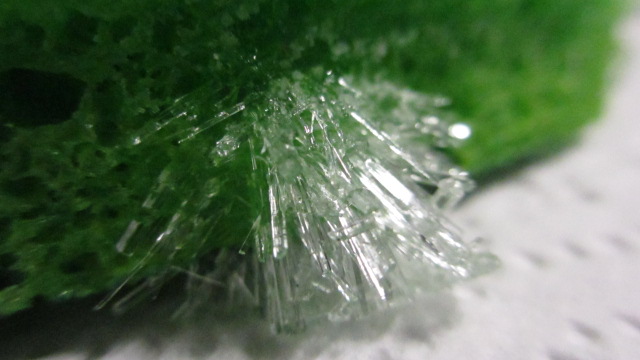
The green sample is the most interesting. The sponge appears to be serving its intended purpose; drawing the solution up through capillary action such that salt crystals form on the surface of the sponge. Less liquid remained in the container at this point, indicating that either more of it was held by the sponge or that it has evaporated off more quickly than the other samples. Again, epsom salt needles can be seen forming in the remaining liquid. They are more pronounced than the ones in the blue or clear samples.


green sample after 6 days
The likely reason that the green sample is having the desired results is that the container is shaped slightly differently. At the beginning of the experiment, the depth of the solution for the other samples was such that the sponges either floated in the liquid or were submerged beneath the surface of it. The green sample is the only one where the sponge sat on the bottom of the container with the liquid not quite covering the top. This would provide for an exposed surface for crystals to form on and allow evaporation to continue as more solution was drawn up through the sponge.


Day 8: Since the solution had almost completely evaporated off of the green sample, I decided to end the experiment at this point and examine the crystals.

blue sample after 8 days
red sample after 8 days
clear sample after 8 days
green sample after 8 days

Here's a close up of one of the surface crystals. It was extremely thin and delicate, and I wasn't able to save it:


The crystals on top of the green sponge are quite small, but packed close together. They reminded me of some of the sugar crystals from the rock candy experiment:


In addition, spiky formations grew out of the sponge near the bottom:


There were also some really pretty crystal formations that I didn't see until I sifted them out with a fork.


This was the biggest one. It formed on the bottom of one of the rounded containers, which seemed to help shape its formation:


Here's one of the larger epsom salt "needles":


Some more formations:


In addition, there were a bunch of smaller, separate epsom salt needles which formed under at the bottom of each container. I sifted them out with a fork, dried them and put them in a pile. A pink tint can be seen on some of them from the red food coloring:


The food coloring idea did not turn out too well; I would need to add way more than I did for the crystals to be colored. As it is, there is only a very slight red tint on some of the epsom salt needles and a faint blue tint on the largest crystal formation (which isn't noticeable in the pictures).

This time I did manage to apply two coats of clear nail polish on several of the crystals to help preserve them (many sites say they will turn white over time otherwise). Letting them sit for a few hours on a paper towel seemed to help their structural integrity such that they could be handled long enough to apply the nail polish. One still needs to be quite gentle, however. I did lose a few spines here and there during the process.

I put the pile of epsom salt needles in a small zip lock bag for safe keeping. I'm planning on using them for a future experiment, since "seed crystals" can help speed up the crystal growing process and provide a site for the new crystals to begin forming.

Monday, February 15, 2016

Sugar Crystals Experiment - Rock Candy

Recipe:
There is a plethora of recipes for rock candy which can be found online. I used a recipe from sciencebob.com which can be found here. I wound up using 1.5 cups of water and 3.5 cups of sugar instead of the suggested 1 cup of water and 2-3 cups of sugar. I probably could have dissolved more sugar, but I ran out. I ended up with enough solution to fill two separate glasses.


Documentation:
I added 1tsp of vanilla extract to the solution. I attempted to add "seed crystals" to the first skewer, but unfortunately I didn't wait long enough for the sugar to dry completely and it fell off when put in the solution. I left the second skewer plain. The skewers were set at 5pm on 2/8/16.

the setup

After 28 hours I checked on the sugar crystals. At this point, crystals were beginning to form on the bamboo skewers. Unfortunately sugar was also solidifying on the edges, top, and bottom of the glass. In the first glass the crystals were smaller on the skewer and there were larger blocks of sugar on the bottom of the glass when compared to the second glass. This is likely because with the first skewer the sugar grains that fell off the skewer provided seed crystals on the bottom of the glass where I didn't want them and lead to fewer crystals growing on the skewer.

For each glass, I cracked the sugar on the surface and gently removed the skewer. Then I poured the solution into a bowl using a spoon to filter out the larger pieces of sugar crystals floating in the solution. Then I rinsed the glass and soaked for a few minutes in hot water and a little dish detergent. This dissolved the blocks of sugar on the bottom. I poured the solution back into the clean glass and replaced the skewer. Some solution was lost during this process.

blocks of sugar forming in the glass
one of the skewers after 28 hours in the solution

The next day, about 48 hours after the start of the experiment, the glasses had again filled with blocks of sugar, even more than the previous day. I decided to end the crystal growth at this point as there wasn't much solution left after again filtering out the excess crystals. I gently removed the skewers and hung them over empty glasses to let the excess solution drip off. The second skewer grew significantly larger crystals than the first one. Another reason for this may be that the first glass was thinner, which may have contributed to the sugar blocks clogging it up faster.

first skewer after 48 hours
second skewer after 48 hours

Close ups of the crystals:


Sunday, February 14, 2016

Epsom Salt Crystals - Refrigeration Method

I recently began experimenting with easy to grow, home made crystals. I started with a recipe I found on about.com. Here is the original article. The steps I took are below.


Ingredients:
1/2 cup epsom salts
1/2 cup water


Recipe:
1) Heat the water (until it's not quite boiling), then mix in the epsom salts. Stir until the epsom salts are dissolved.

2) Put the mixture in the refrigerator and wait several hours.

3) Once crystals have formed, gently remove them and let dry.


Documentation:
The recipe was completed and the bowl put in the fridge at 8pm on 2/7/16. No sign of crystals after 1 hour. Very small crystals forming at the bottom of the container after 2.5 hours. After 5.5 hours, there are clear crystals forming on the bottom of the bowl, although they are still quite small. I decided to leave the bowl in the refrigerator overnight.

After a total of about 14 hours, I removed the bowl from the fridge. The epsom salt had formed a mostly flat layer on the bottom of the bowl, but some small crystals can be seen growing up from there. I removed this formation from the solution and kept a small sample.


the bowl I used to grow the epsom salt crystals

right after removing the crystals from the bowl

a smaller sample piece that I kept


Note that in the original article, it says that "the bowl will fill with needle-like crystals within three hours". In my case I didn't see many crystals after three hours, and waited overnight instead to get results I was satisfied with. Also, the crystals only formed on the bottom of the bowl. I may repeat the experiment with different water temperatures and containers with different shapes (a deeper cup and a bowl with greater surface area and less depth) to see if I get different results.

All in all, however, this was a very simple, easy experiment and the epsom salt crystals turned out pretty well. The sample piece I kept can be seen in the third picture. I tried applying clear nail polish to other pieces, as I've heard this is one way to preserve the crystals, but they kept breaking apart as I held them. Attempting to hold them from the sides does seem to cause them to break easier.


Sunday, December 29, 2013

Poem: Hope and Apathy

One can almost be at peace, with apathy.
It is the first sliver of hope which hurts the most,
Making it impossible to ignore the looming mountain of doubt.
The process is painful, and it hurts,
But the growing hope can heal,
And within even the smallest piece,
The beauty of the universe is contained.

Tuesday, December 25, 2012

Dream Fragments

I want to get back into the habit of recording my dreams, which I find makes a huge difference in their clarity and how interesting they tend to be. I decided to create a blog for anyone who might be interested in reading some of the more interesting ones I've written down (which at times read like stories), which can be found at nautilusdreamfragments.blogspot.com

Wednesday, December 19, 2012

Sleeping in the Cold

A few days ago, a visiting friend and I were walking home from a late night movie. It must have been past 1am. While walking along, we passed by a couple of people in an underpass. One was huddled on the ground, asleep, and the other was laying down a blanket, getting ready to settle down for the night. For some reason the sight affected me very strongly. Just from being outside for a few minutes I was quite cold, despite having a sweater. And here were people who slept out here.

I can remember countless times I've walked by homeless people during the day who asked for change. At various stage in my life, I've either been in the habit of giving change or not. Even when I was in the habit of doing so, however, I never really felt like it made a difference one way or the other. This was different. These people weren't asking for anything. They barely even seemed to register us passing by. They were just going about their daily lives. Just as I pull my blankets around me every night and fall asleep in my home, these people pull their blankets around them and fall asleep... outside, in the cold.

My friend and I stopped by the local grocery store to get some snacks, and on an impulse I found myself staring at the polar fleece blankets. They were designed to be holiday house warming gifts, just thin throws with pictures of penguins and whatnot on them. But it was all they had, and in the end I decided it would be better than nothing. When my friend realized I wasn't getting it for myself, she covered half the price. We made a detour on the way home, back to the underpass. Both people were asleep by then, so I just set the rolled up blanket next to them and left. Somehow it seemed better that way.

And I've been worrying about them ever since.

Sunday, November 4, 2012

Pictures from Around the Campus

I've been taking some time lately when I'm on campus, between classes, to relax and look around. I've gotten into the habit of keeping my camera around whenever I see something that really intrigues me. I'm rather obsessed with clouds, for some reason.


Once I was sitting in my favorite spot on the stone bench which looks out towards the mountains, and I somehow managed to get a shot of a blue jay in mid-flight; it was just changing directions before flying almost vertically into a tree.


Another one of my favorite experiences was a couple weeks ago, when I could see reflections of the sky on the cement right after it finished raining.

From some angles, the puddles almost looked like portals into another world.

I don't know what it is about having a camera in my hand, but it makes me look at the world differently. Even if I'm just on a lunch break.

Thursday, June 21, 2012

Existentialist Love

I have several definitions of love. The one I'm going to talk about in this post is the weird, existential definition I've been developing.

Philosophical speculation has left me with the following (nope, not answer...) question: Never mind "what's the meaning of life", why don't I know it already, inherently, simply by existing? There are many religions and theories that deal with finding an "ultimate meaning", and personally I think it is indeed possible to discover such a state of existence where everything is whole and makes sense. However, there is still no (satisfying) explanation for why something is missing in the first place!

Neither logic nor emotions bring me any closer to finding an answer to such a question. Thinking about it only leads me in circles until I'm convinced that it simply does not make sense! And so, all I can do is look at the facts; here we are with this confusion, this lost feeling, this unidentifiable "missing piece" in existence. Here we are, capable of both deep joy and deep dissatisfaction. While I believe that a state of being must exist where everything makes sense and is whole, evidently there are also states of being where things don't make sense, and something is missing. Such is life as we know it.

This is where love comes in. None of us have all the answers. None of us are completely whole. However, each of us have found reasons to continue existing. We wouldn't be here otherwise. Each of those reasons are at least slightly different. At the same time, humans have enough in common with one another that many of these reasons can be communicated. Some people may be a lot closer to happiness and meaning than others, but everyone can benefit in one way or another from kindness and communication.

In one definition, love means caring about another person, wanting them to be happy, and doing or saying whatever is necessary to help them see meaning in life. Lyrics from a song by the Beach Boys (of all things) started me on this train of thought. It's the one that goes:

I may not always love you,
But as long as there are stars above you,
You needn't ever doubt it,
I'll make you so sure about it.


Really sweet, right? And a really interesting way of phrasing things. But it's the next verse that got me thinking:

If you should ever leave me,
Well life will still go on believe me,
The world could show nothing to me,
So what good would living do me?


So this song is describing the classic kind of romantic love where two people feel like they need each other so badly that if separated they're just... horribly depressed. But that line, "The world could show nothing to me", made me really sad. Myself, I've never been in a relationship with a guy, not even close. And yet, the world has shown quite a lot to me. Beauty and meaning is always there, waiting for me to recognize it. I've been heartbroken before, and the world was still there, happiness could still reach me when I looked beyond my pain.

I started thinking; if ever I wind up with a life partner and I died first, I would want them to continue to find beauty and meaning in life, even without me there. Seen from this perspective, love means communicating my own ability to be happy as best I can; it means I have one lifetime to pass on whatever I learn about happiness and meaning.

On a larger scale, it means that those who live on must remember the teachings of those who have died, so that they can in turn build on the knowledge and pass it on to the next generation. Caring about another person means wanting them to be happy, which means wanting them to have the ability to find happiness on their own, even when you are no longer there to guide them directly.

This concept is not limited to life partners; it applies to all human interaction. One lifetime is the maximum amount of time any person has to give what love and guidance to others that they can. But even passing a stranger on the street, just once, provides the opportunity to communicate meaning, in one way or another.

Love means helping each other, in whatever way possible, to see what the world has to show.

Saturday, June 16, 2012

The Beauty of Flight

Earlier this week I sat in a plane, looking out the window as it took to the sky. I've always loved flying. This particular experience had a more surreal quality to it than usual. I watched the city below disappear to be replaced by farmland, then deltas; tendrils of clear water reaching out across the cracks in the land. Before long, I was looking down on the tops of cumulus clouds, the light from the sun coloring them from the sides, the subtle shadows making them appear soft and yet more substantial than they are in reality.

It was a sea of clouds like this, as far as the eye could see. The beauty of what I saw made my eyes start to water. It reminded me of those times I would look up at clouds from the ground and think of how they looked just like the Renaissance paintings of the heavens. Only, the shapes of the clouds from above looked different. I realized that the people who created such paintings had never seen the sky the way I was seeing it now. I realized that throughout history, there have been humans who have always dreamed of flight, that they could only have imagined an experience such as the one I was having now.

I thought about how it must have felt to be one of those first few people to go into space, to see their entire planet from far away. I thought of how most of us, if given such an opportunity, would be overcome with wonder. And yet today millions of people board airplanes, take to the sky, and go places our ancestors could not even come close to reaching. What is now common was once unimaginable.

That day I counted myself lucky. Had fate been different, I could have easily been a land-bound dreamer, staring up at the sky and wondering what was up there. Instead, with barely a thought at the start, I was flying. For the sake of all my ancestors with unfulfilled dreams of flight, I took in all I saw around me with the same wonder I would feel if I were drifting through the cosmos and amongst the stars.

Wednesday, May 30, 2012

The Checklists of Life

Many of us seem to think of happiness as a mental checklist, where once you have checked off each item on the list you will have achieved total happiness. Common, cliché items on the list include finding the right spouse, having children, getting a car and house of your own, having a successful career,  retiring to Florida or wherever... I think most people are actually quite conscious of the checklist at this level. Some may chose to aim for completing the entire deal, whereas others may pick and choose which items they'll aspire to and dig their heels in against the rest.

But what wasn't immediately apparent to me is that there are checklists within each of these larger items. For example, the checklist for a romantic relationship. There are some of the more obvious clichés to choose from (eg. “a first date involves going out to dinner and a movie, or perhaps just coffee or a beer”), then there are much more subtle ones; details that at first glance appear to give meaning to a relationship, but on closer inspection are really just common themes in the stories we watch, read, and tell ourselves and each other.

Personally, such checklists have a nasty tendency to upset me. I've never been entirely sure whether it's because I'm so much further behind in checking things off than my peers or if it's because I can't quite seem to bring myself to accept these happiness lists as my own. In theory, I should be able to compile my own checklist for happiness, then follow that.

Easier said than done. From all my personal experiences of true happiness, there is no item I can pinpoint and say, “That's the key right there!” and then expect the feeling to happen in a predictable or permanent way. In reality, there is so much richness to life, so much variation and depth of meaning to be found from the smallest blade of grass to peace between nations, that no checklist could ever be long or precise enough to guide an individual to the purpose behind living.

In my experience, happiness is not something to be acquired at the completion of some task or the acquiring of some goal. It is a state of mind. It is lost and reborn in every moment of its existence. Every instance of happiness differs from the last from the subtlest of ways to the most definable. Environment and circumstance may help determine the tendency towards or away from happiness, but ultimately it is a matter of perception. Those able to see the good, even in the presence of the bad, will be much more likely to feel good about life.

While I might not be able to provide specific directions for being happy, I have been trying to form a rough idea. Here's my “checklist” of ingredients for happiness:
_The absence of perceived judgment from others and any other obstacles to being true to oneself.
_Mind focused on the present (no anxiety for the future or guilt from the past).
_Any reason, large or small, for life to be seen as beautiful and meaningful, even if “this is all there is”.

Friday, May 25, 2012

Talking about Problems Vs. Talking about Solutions

For anyone who has ever realized how messed up the world is and that reality hardly seems to live up to ideals they grew up believing in, it's only natural for their first reaction to be to wonder why on Earth no one seems to see these horrible problems very clearly. Why don't more people care? Why don't more people do something? Do people really want to live like this? These are the questions that plagued my mind when I first started to truly, deeply question the culture I've lived in all my life. I had doubts before, but it was too terrifying to look at them closely. Because it goes without saying that changing the world is more than a one-person task. I eventually chose to look at the world's issues despite my fear because the world's problems are my problems; they affect the choices I make and the quality of my life... and everyone else's.

So for years I questioned my preconceptions, started looking at life from as many different perspectives as I could think of. And as of late I've even started to whole-heartedly believe that a more humane, meaningful and connected life and community is possible. However, one thing I haven't done much of is act. Action towards forming a new kind of culture or community requires not feeling alone. Not feeling alone requires seeking out others who are also willing to look at and question the world's problems. And here's the important point, the thing which has thus far kept me from action: many of the people I personally encounter who are willing to look at problems are like me; wondering why other people aren't waking up.

The thing is, amazingly, I never consciously realized (or perhaps admitted) just how many other people are “awake”. It's more than a case of chronic preaching to the choir; it's not even being aware that you have a choir, and a large one at that. Granted, they may not be singing in the same key, but that's not the point. The Occupy movement, for example, has been one of the most beautiful affirmations of humanity I have ever witnessed. And it has certainly redefined my conception of how many people are not only conscious of a broken system, but willing to speak openly about it.

Continuing with the “waking up” metaphor, I'm starting to think that maybe it's not so much that more of us need to wake up, but that more of us need to get out of bed, walk out our front doors and say hi to our neighbors. (It probably wouldn't be a bad idea to do this literally, either.) So here's what I intend to do: stop feeling so alone and give people more credit. The number of conscious but lost humans will always be underestimated simply because we assume we're more alone in our fears and goals than we really are.

Perhaps convincing everyone there is a problem is not a required first step. Perhaps all the resources needed to make a change are already in place. Perhaps we can start right in on talking about and finding solutions. After all, “the masses” may be much more willing to wake up and join in if they see something beautiful being created. Rather than someone bludgeoning them over the head with guilt trips and horror stories. It's like waking up to the morning sun peaking through the window, the sound of chirping birds and the faint smell of someone making coffee and maybe some bacon... instead the incessant racket of a blaring alarm that just makes you want to hit the snooze button repeatedly or possibly have done with it already and smash the blasted electronic contraption to smithereens.

In conclusion, I'm going to stop beating my head against a brick wall, go find others who are currently beating their heads against brick walls and suggest an alternative :)

Friday, April 6, 2012

Code Names

A conversation from a few weeks ago:

Me: “My female friends and I come up with code names for guys so we can talk about them without others knowing who we're referring to. Guys we're interested in, guys that are friends, guys we can't stand, guys we barely know... But never for other women. Why is that?”

My dad: “It's because men are an alien species.”

Me: “I KNEW IT!!!!”

Thursday, April 5, 2012

Living in the Present

I think the happiest people are those who live in the present. When it comes to thinking optimistically, it's so much easier to do so by escaping to the past or future; reliving happy memories or imagining the way things might eventually be. Living in the moment sounds great. And it is... right up until you get bored in the moment. Or things could be better than they are. Or something not so pleasant happens. Suddenly, memories and imaginings start looking so much more appealing.

The reason that I think those who live in the present are happiest is because they don't try to mentally escape their life. If they become bored with something, they search for interest in the situation. If they're depressed about the way things are going, they look around themselves for something to be happy about. By turning to memories and plans when life becomes less than ideal, future and past thinkers inadvertently wind up placing more value on some experiences more than others. Those who consistently live in the present, however, develop the ability to find happiness in a much wider variety of experiences.

Another advantage of the present is that it feels more real than the past or future. This may sound obvious, but when faced with a choice between an unpleasant present and a vague but happy memory, I suspect most people would go for the memory. This doesn't completely solve the problem. You only escape the present to the degree that you are able to imagine things or recall events and feelings clearly.

In contrast, someone who is used to living from moment to moment will have a higher capacity for changing their perspective of the situation, in some cases turning an unpleasant experience into a meaningful one. The present thinker may wind up happier than the past or future thinker because not only can they find meaning in a wider range of situations, but their experiences tend to be more real. (As an aside, really taking in everything around you and observing many different aspects of life will also help with improving both imagination and the clarity of memories.)

Undeniably, it's still useful to know how to plan ahead, or learn from the past. There may be times when these skills are needed to take action or add context, and a change in perspective in the "now" may not always cut it.

However, I know that I, for one, am particularly underdeveloped in my ability to stay focused on the “now”. Personally, when I try to live in the present for any extended period of time, I inevitably have the thought, “So... is this all there is?” Even when life around me is going very well and I have a strong feeling of contentment, such a thought is nevertheless quite unnerving. Perhaps it just shows how ingrained my habit of always looking for “more” is. In any case, I look forward to gaining experience on how to live from moment to moment.


I'd be curious to find out where other people spend most their mental energy: the past, present, or future :)

Wednesday, April 4, 2012

Living in the past

As mentioned in the previous post, I tend to live in the future. Others, however, might choose to live in the past. A good example is my mom. When I was a kid, I used to get upset when I only had a couple weeks of summer vacation left. My mom would always try to cheer me up by saying, “But you had such great summer! Think about all the times we went to the park and the beach and how...” and she would list a few things then try to get me to add to it.

At the time, this only served to heighten my despair. I was a future thinker; I'd be thinking, 'yes indeed, summer vacation is really great... and it's about to be over!' It was baffling, back then, that my mom thought the past could hold any consolation for me. In hindsight, it's clear that my mom had experience deriving joy from memories and simply assumed I had the same ability. In fact, I barely began to reflect on my past at all until my early teens.

When I first started thinking in terms of the past, it was mostly regrets; things I wished I hadn't done and, even more often, things I wish I had done. Unfortunately, the past usually just left me crushed with guilt. I didn't like thinking about it because I wasn't totally happy with who I was as a person. That's why thinking about the future was so much more appealing. With the future, I could still become anyone. The good news is that once I started looking back on my life, I started to understand how certain events had shaped my values. I didn't always embody the values I believed in, but at least I began to identify what they were.

For quite a few years still, even happy memories of the best parts of my childhood only served to make me wish I could turn back time. I didn't seem to be able to look back without rewriting certain events and even my own perspective. My imagination was constantly at work on my memories, making edits to create a story that would only have been possible if I had learned early on lessons that can only come from hindsight.

Later, after I became an optimist, I began to learn the art of accepting good memories as they are, leaving them unchanged and experiencing their joy all over again. Sometimes even more joy than I felt at the time. For me, it's not quite the same as simply reliving the past like a scene from an old movie. It happens when, for example, I'm walking home from the bus stop and I catch the scent BBQ somewhere in the neighborhood. It reminds me of times in my childhood when my family and friends and I would be out in the woods having a BBQ picnic.

The present gets linked to the past and the result is a feeling better than either one on its own. If I hadn't had those memories, the scent of BBQ would have merely been some odd scent (or perhaps it would have just made me hungry). And while I may have been happy and content back when I was a kid, the present experience provides another layer of meaning, since I've had time to learn to appreciate things in new ways.

The past is a great tool for understanding yourself better, and for learning from your mistakes. But living too much in the past presents similar problems as living too much in the future. Guilt is only useful to a point, after which it can stifle your confidence and creativity, keeping you from moving on and changing. Even dwelling too much on good times that are over can hinder the forming of new ones. As with the future, the key is not to spend all your mental time there. Instead, visit your memories from time to time, learn from them, and use them to reinforce what you believe in and what gives you happiness.

Tuesday, April 3, 2012

Living in the Future

My own tendency, I find, is to live in the future. What I mean by this is that I'm constantly thinking ahead of where I am. I'm constantly planning, thinking about the next thing I have to worry about or to look forward to. If I have nothing I need to do on a particular day (a rarity for a college student such as myself), I find myself looking ahead to the next task I can think of. And once I have that task figured out, I plan further ahead. And once I've planned as far as I can in detail, I start thinking about where I'm going with my life in the long run... What I inevitably find is that it is pointless to try to see more than a few years ahead of myself. Sure, it can be done, but meaning seems to dissolve whenever I try.

The few times I have attempted to lay my entire life out in front of me, like a story plotted out onto a time-line, I've been seized by a sort of, for lack of a better phrase, “existential despair”. Looking at my life in such a way seems to shorten it and cause it to loose all it's depth; relationships are reduced to formulas and scripts, hobbies become a way of using up time, careers a way of filling up the time between hobbies and beauty and happiness become stagnant ideals.

Needless to say, I don't like to go to quite that extreme when I think ahead of where I am. However, I do have a habit of looking ahead to my next goal or thing I want and planning it out in great detail, inventing in my mind a detailed scene or a set of events to make up a story. At some point I realized that the purpose of this was not merely to plan for practicality's sake, but to give myself something to think about that would make me happy. So I want something now that I don't have? No problem! I have imagination. I can just create it in my head. If I think about it long enough, it'll eventually become as potent an experience as a memory.

One of the more obvious problems occurs when my goal is too far away or unrealistic to come true anytime soon, but close enough to reality that I don't recognize it as a fantasy. A memory or imagined event can never seem to reach the same strength of experience as the present, and the contrast between the happy but vague future improbability and the reality of the pesky present is the source of much frustration.

There are more healthy and practical ways to use thoughts of the future. For example, planning ahead in the sense of thinking about what needs to be done, deciding what you're going to do and when, then letting it go until action is required. Also, looking to the future can be used as a form of optimism, as a way of seeing creative possibilities or building confidence in your abilities (if you're not able to do something in the present, you still have time to develop new capabilities to attain your goals in the future). The thing to stay away from, as I know all too well, is living so much in the future that you fail to see what you have in the present.

Friday, March 30, 2012

Arbitrary Division


I want to learn about my people. All of my people.

For years now, I've been struggling with my cultural identity. At first glance, I thought I didn't have one. Others seemed to be so sure about what cultural group or subgroup they belong to. Many have traditions and values going back an untold number of generations. But I was always at least a little outside of these groups and subgroups. Even the ones I later identified as mine (the “American”, the sci-fi lover, the math geek, etc.)

This made me feel... disconnected, somehow. Disconnected because from time to time I would glimpse personal meaning in those traditions, stories and customs. And yet, because those traditions were not mine, because I was not a full member of those groups, and because I could not bring myself to accept 100% of any given set of values, I remained an observer. Don't get me wrong, one can potentially learn a lot as an observer. But not everything I need to learn. It's always, “Hey, that's an interesting culture, I wish I knew more about it”, and rarely, “The meaning behind that tradition is part of me”.

However, perhaps I am lucky that I don't fit into any one particular group. There may be some I would thrive in more than others, but I don't think I could ever again limit myself to a single outlook. Not since the first time I saw things from a new and completely different perspective. Today I realized what group it is that I belong to: humanity. Yes, I've thought this before, as passing idea, but today I truly believed it, felt it so clearly that it's as if it's always been this way, though I know I haven't always seen it as such.

War cannot even pretend to make sense to me now. The invisible walls between peoples, proclaimed to be so impervious by those who work so hard to make them, are like tiny lines drawn in the sand. It's as if I spent my whole life studying those lines, pondering over the symbology and meaning of their shapes as they are drawn and redrawn whenever waves obscure them, only to realize one day that it was only sand I was looking at all along.

Sunday, February 12, 2012

Confusion about Selfishness

Have you ever been worried about being too selfish? It's an issue that seems to come up a lot and yet, like anything taken to an extreme, it eventually becomes clear that it's impossible to be completely selfless. Even the motivation behind wanting to become selfless is, in itself, selfish. One day it occurred to me that if humans were meant to be purely selfless, we would have given up our bodies to nourish the first predator or bacterial colony we encountered.

But even if you limit the question to human interaction, there is still only so far you can go with selflessness. True, not everything has to be a tit-for-tat interaction. Random acts of kindness, for example, can involve giving to strangers who will never know who exactly did the giving, thus eliminating the risk of someone giving only because they expect something in return.

In fact, with a random act of kindness what you get out of it is that happy feeling for having done a good deed. Wait a minute, you get something out of it?! Doesn't that make it selfish? Can't have that... Alright, so doing an anonymous good deed is selfish too, but so what? What harm is there in that particular selfish motivation? If you think really hard, you can probably come up with some scenarios where a person obsessed with doing good deeds could become delusional and wreak havoc on their community... but first of all, what are the chances of that happening, and second of all, it still seems far less harmful than, say, a serial killer let loose in that same community.

Both the serial killer and the good-deeds-obsessed person have selfish motivations, but the difference is that the serial killer is really bad at managing them. The problem I see with the good-deeds-obsessed person is not that they aren't selfless enough, but that they might not be willing to accept their own selfish motivations. This means that while their good deeds might be much closer to the "purely selfless" ideal than the norm, they might not act as often as they could. They might come up with some idea for a nice thing to do, then think, "Oh no, I have as much to gain from that as I'd be giving, so I can't do that. I'll just wait until I come up with a better idea."

If all a person ever did was anonymous acts of kindness, I'll bet they would still feel like something was missing. Sure, the need for feeling good about your moral integrity might be accounted for, but there are still other needs like safety, food and shelter, human connection, feeling loved and appreciated, having a valued place in the community, etc. My point is that people should pursue their own selfish needs, so long as they put a bit of thought into how they go about it.

It's entirely possible for someone to act on extremely selfish motivations, but do it in such a way as to greatly benefit everyone around them. In other words; mutual benefit. Otherwise, no one would ever have friendships or relationships. True, there are plenty of examples of unhealthy relationships where one person is doing all the giving without getting any support in return, but there are also examples of people that know how to have their needs met while simultaneously providing for other's needs.

So forget about, "How can I be purely selfless?" I think a far more interesting (and practical) question is, "What are some creative and mutually beneficial uses for selfishness?"